
Private Equity Allocations at Canadian Pension Plans
Institution | 2010 | 2025 Q3 |
|---|---|---|
CPPIB | 12% | 291 |
Ontario Teachers | 11% | 232 |
CDPQ | 11% | 193 |
PSP | 12% | 124 |
OMERS | 12% | 195 |
Private equity offers increased return potential with lower volatility compared to traditional equity investments.
This asset class involves purchasing equity in companies not publicly traded, managed by sponsors who provide hands-on management to improve operations.
Returns typically come as capital gains upon portfolio company sales, delivering substantial total returns with lower volatility than public equities.
Download our Guide to Private Equity Schedule a Consultation
Private equity (PE) represents a distinct investment class where capital is channeled into companies that are not publicly traded on a stock exchange. These investments are typically facilitated through specialized private equity firms, which manage funds sourced from various institutional and accredited investors, aiming to acquire, manage, and ultimately sell these private entities.
At its core, PE involves an active ownership approach. Unlike passive shareholders in public companies, private equity sponsors (often referred to as General Partners or GPs) take a significant, often controlling, interest in their portfolio companies. Their role may extend beyond mere investment; they may actively engage in operational improvements, strategic guidance, and financial optimization to drive substantial value creation over a defined investment period, usually several years.
The primary objective of these investments is to generate capital gains. Returns are typically realized upon a successful "exit," such as the sale of the portfolio company to a larger corporation, another PE firm, or through an initial public offering (IPO). Investors are drawn to private equity for its capacity to deliver compelling long-term returns, its reduced sensitivity to public market fluctuations, and its potential for portfolio diversification due to a lower correlation with traditional asset classes.
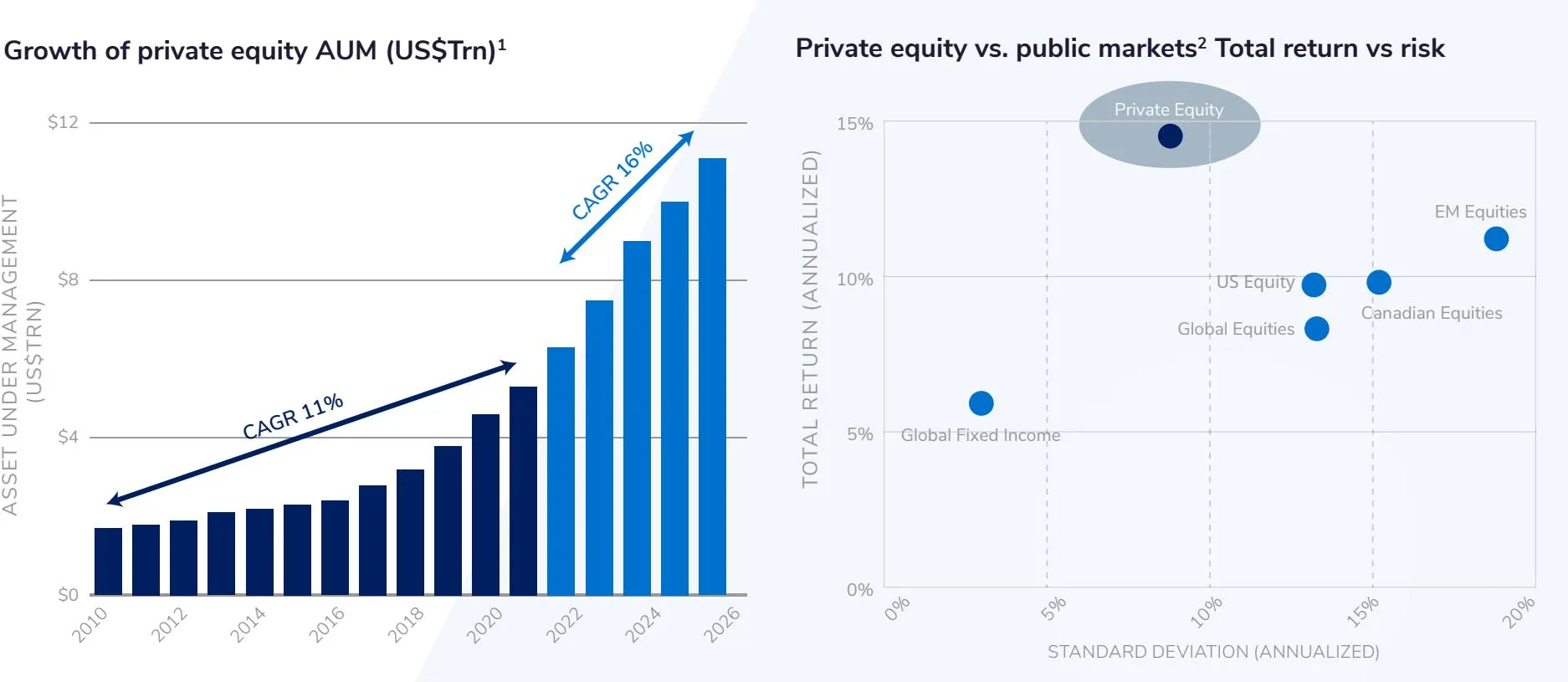
Private markets offer significantly greater depth than public markets, with many more privately held companies than publicly listed ones. This is particularly true for medium and smaller sized companies.

Investment in private equity allows investors to participate in the significant global business activity and value-creation that occurs outside of public markets, while bringing diversification benefits given its limited historical correlation to traditional asset classes.
Source: (1) 2021 figure is annualized based on data to March. 2022-2026 are Preqin’s forecasted figures. 2 Sources: Private equity data provided by Cambridge Associates. Public market indices provided by Morningstar Direct. Private Equity: Cambridge U.S. Private Equity Index (Legacy), Canadian Equities: S&P/ TSX Composite TR, US Equities: S&P 500 TR, Emerging Markets: MSCI EM IMI NR, Global Fixed Income: ICE BofA Global Broad Market TR HCAD, Global Equities: MSCI World NR. Time period, 10/01/2001 – 09/30/2021. Private equity returns are shown net of fees, expenses and carried interest. Data denominated in CAD. Standard deviation is a measure of how much an asset’s return varies from its average return over a set period of time and is commonly used to assess volatility in investment fu
Institution | 2010 | 2025 Q3 |
|---|---|---|
CPPIB | 12% | 291 |
Ontario Teachers | 11% | 232 |
CDPQ | 11% | 193 |
PSP | 12% | 124 |
OMERS | 12% | 195 |

Canadian pension plans and other large institutional investors have significantly increased their allocations to private equity over the past decade, recognizing its enhanced risk/return potential and opportunity to capture an illiquidity premium.
Early-stage companies
Expanding companies
Established companies
Underperforming companies
Each strategy targets companies at different lifecycle stages with unique risk-return profiles. Private equity sponsors typically specialize in one specific area.
Private equity investments are relatively illiquid but compensated by higher expected returns—the "illiquidity premium."
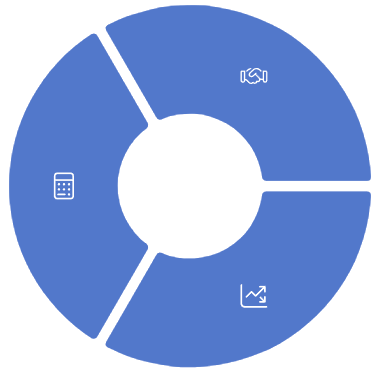
Forecasting future cash flows and applying risk-based discount rates to determine present value.
Using valuation multiples from similar private market transactions.
Applying valuation multiples from comparable publicly traded companies.
Valuations typically occur quarterly with 30-90 day lags, contributing to lower volatility than public markets.
The demand for private equity (PE) has never been higher, with PE now generally seen as an essential building block of a well-diversified portfolio.
While private market investments traditionally remained out of reach for retail investors, there's reason to be optimistic about the democratization of this asset class. Innovations in product design are making private equity more accessible and more liquid, with reduced investment minimums. New products structures, such as feeder and interval funds, are helping make PE accessible to more investors while maintaining professional management and risk oversight.

As capital markets evolve and investor demand for alternatives grows, more retail investors will benefit from the substantial value creation and attractive returns generated by private equity.
Private equity offers strategies investors can use to complement public market investments to produce better absolute and risk-adjusted returns.
Transactions are sourced and privately negotiated. Capital is gradually called from investors to finance acquisitions.

Growth is driven by strategic initiatives, mergers, operational improvements, and management enhancements.
Transformed companies are sold, gains are realized, and cash is distributed to investors after 4-7 years.
This commentary is published by IG Wealth Management. It represents the views of our Portfolio Managers and is provided as a general source of information. It is not intended to provide investment advice or as an endorsement of any investment. Some of the securities mentioned may be owned by IG Wealth Management or its mutual funds, or by portfolios managed by our external advisors. Every effort has been made to ensure that the material contained in the commentary is accurate at the time of publication, however, IG Wealth Management cannot guarantee the accuracy or the completeness of such material and accepts no responsibility for any loss arising from any use of or reliance on the information contained herein. Commissions, fees and expenses may be associated with mutual fund investments. Read the prospectus before investing. Mutual funds are not guaranteed, values change frequently, and past performance may not be repeated. This commentary may contain forward-looking information which reflect our or third party current expectations or forecasts of future events. Forward-looking information is inherently subject to, among other things, risks, uncertainties and assumptions that could cause actual results to differ materially from those expressed herein. These risks, uncertainties and assumptions include, without limitation, general economic, political and market factors, interest and foreign exchange rates, the volatility of equity and capital markets, business competition, technological change, changes in government regulations, changes in tax laws, unexpected judicial or regulatory proceedings and catastrophic events. Please consider these and other factors carefully and not place undue reliance on forward-looking information. The forward-looking information contained herein is current only as of 10/31/2022. There should be no expectation that such information will in all circumstances be updated, supplemented or revised whether as a result of new information, changing circumstances, future events or otherwise. Mutual Funds and investment products and services are offered through Investors Group Financial Services Inc. (in Québec, a Financial Services firm). Additional investment products and brokerage services are offered through Investors Group Securities Inc. (in Québec, a firm in Financial Planning). Investors Group Securities Inc. is a member of the Canadian Investor Protection Fund. Trademarks including IG Wealth Management and IG Private Wealth Management are owned by IGM Financial Inc. and licensed to subsidiary corporations.