Investing in Private Credit


Private credit has evolved into a well-established asset class that continues to gain importance in today's investment landscape. This diverse market offers strategies ranging from capital preservation with stable income to more aggressive total return approaches.

Investors primarily seek private credit for its enhanced yield potential compared to traditional fixed income securities. Beyond higher returns, it provides valuable portfolio diversification benefits, particularly in larger multi-asset portfolios.

Our comprehensive guide helps you navigate this growing alternative investment sector with insights on risk management, opportunity identification, and strategic implementation.

logo

Why Private Credit?


Private credit offers investors unique advantages in today's challenging market environment. With traditional fixed income yields compressed, many institutional and high-net-worth investors are exploring this alternative asset class for enhanced returns and portfolio diversification.

Understanding Private Credit Fundamentals


Private credit represents lending to businesses by non-bank institutions, providing financing solutions for companies requiring capital for strategic acquisitions, organic growth, or balance sheet optimization. Most borrowers tend to be private companies seeking more flexible terms than traditional bank financing can offer.

This specialized lending primarily serves the "middle market" – an economically vital segment comprising mid-sized companies with proven business models and established market positions. These companies typically generate between $10 million and $150 million in annual EBITDA but often fall outside major rating agency coverage.

The rapid growth in private credit has been fueled by two key factors: post-financial crisis regulatory reforms that restricted bank lending capabilities, creating a funding gap for alternative credit providers to fill; and the expansion of private equity activity, which increased demand for creative, flexible lending partners.

Why Companies Choose Private Credit

  • Access to capital when traditional bank financing is unavailable
  • More flexible terms and customized structures
  • Faster loan processing and execution
  • Relationships with knowledgeable lending partners

A Well-Established Asset Class on the Rise

The Symbiotic Relationship Between Private Credit and Private Equity


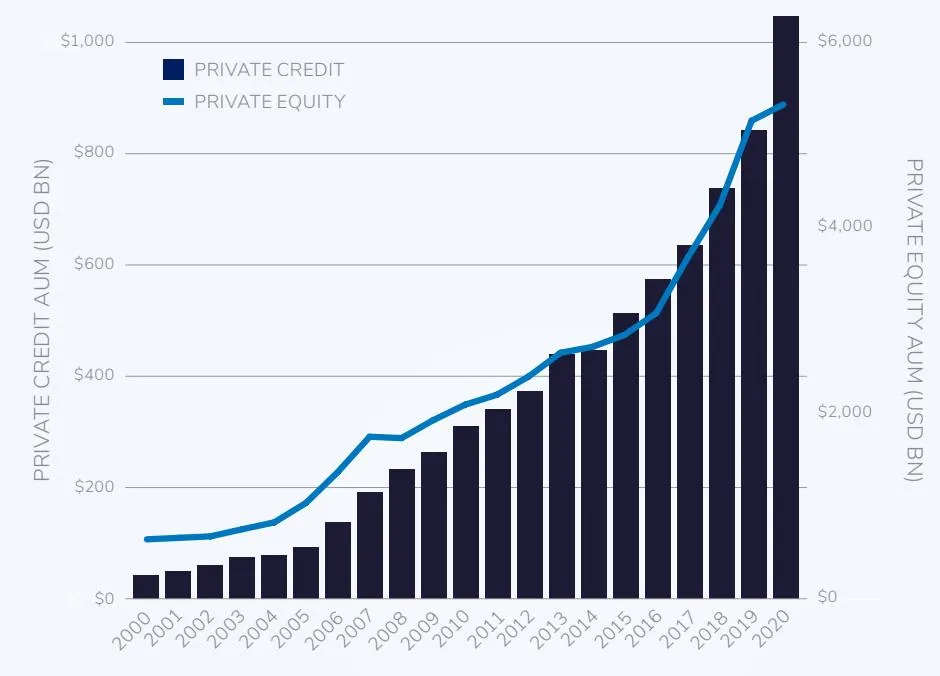
Private credit has emerged as a critical component of the alternative investment landscape, growing in tandem with private equity. This symbiotic relationship drives deal flow and market expansion:

  • Private equity firms use leveraged buyout transactions to acquire target companies
  • These transactions incorporate debt financing as a significant portion of the capital structure
  • After acquisition, private equity partners implement growth strategies before eventual resale
  • Private credit lenders provide the specialized financing that makes these transactions possible

Strong relationships with private equity firms give private credit managers consistent deal flow, allowing them to maintain diversified portfolios and deliver competitive risk-adjusted returns to investors.

graph

The private credit market has experienced extraordinary growth, expanding from under $50 billion in 2000 to over $1 trillion by 2020. This trajectory reflects increasing institutional adoption and the fundamental role private credit plays in today's financial ecosystem.


1) Preqin Global Private Debt report 2024

Specialized Expertise: Critical for Success in Private Credit


The private credit market's decentralized nature requires highly specialized analysis capabilities to properly evaluate mid-sized private companies. This creates both challenges and opportunities for credit providers, particularly in niche industries where only a select few lenders can offer customized financing solutions.

These market dynamics can generate attractive risk-adjusted return opportunities due to favorable supply/demand conditions. However, successfully capitalizing on these opportunities demands extensive capabilities:

  • Sophisticated deal sourcing networks
  • Rigorous screening and selection processes
  • Efficient execution capabilities
  • Comprehensive monitoring systems
  • Deep industry relationships

"The ability to continuously source, screen, select, execute and monitor a sufficiently large pool of private credit deals requires a broad platform, a knowledgeable team and extensive relationships."

The significant barriers to entry in private credit mean successful managers can develop substantial competitive advantages over time. This makes investor due diligence in manager selection absolutely vital for achieving desired outcomes.

Understanding Credit Risk in Private Lending


Private credit funds can be structured for various risk and return objectives. Before investing, careful consideration of risk factors is essential, particularly credit risk – the probability a borrower will fail to make timely interest and principal payments, and the expected severity of losses should they occur.

The 4 Cs of Credit Analysis

These fundamental factors form the foundation of comprehensive credit risk assessment in private lending.


Capacity

A borrower's ability to service their debt obligations, influenced by industry structure, company profitability, cash flow metrics, and existing debt levels. This factor examines whether the business generates sufficient cash flow to meet payment obligations.

Covenants

Legal terms specifying borrower obligations and management limitations designed to maintain credit quality. These include payment requirements, financial statement filings, and maintaining specific financial ratios to provide early warning signals.

Collateral

The quality and value of a borrower's assets that can be liquidated or monetized to limit creditor losses in default scenarios. Strong collateral provides lenders with downside protection and recovery options if performance deteriorates.

Character

The nature and intentions of company equity holders, corporate strategy quality, management team track record, and governance practices. This qualitative assessment evaluates leadership integrity and capability to execute business plans.

Key Risks in Private Credit: Capital Structure Positioning


A company's capital structure – the mix of debt and equity – often includes distinct layers with varying seniority. This seniority determines priority claims on company assets in default or bankruptcy scenarios, directly impacting risk and return profiles for investors.

pyramid


Senior Secured Debt

Highest priority claim on assets

Junior Secured Debt

Secondary claim on pledged assets

Senior Unsecured Debt

General claim without specific collateral

Junior Unsecured Debt

Lower priority general claim

Preferred & Common Equity

Lowest priority claims

logo


Higher-ranking debt typically receives lower interest rates than lower-ranking debt but benefits from preferred treatment in default scenarios. This risk-return tradeoff is fundamental to private credit portfolio construction.


Secured Lending Types

  • Asset-backed loans: Specific assets pledged as collateral
  • Cash-flow based loans: Secured loans without specific asset collateral

Key Risks in Private Credit: Liquidity Management


"It is crucial for investors to understand the liquidity characteristics of a private credit strategy before investing."


Liquidity Risk Management

Liquidity refers to how easily investments can be bought or sold in secondary markets without significantly impacting price. Private credit managers typically originate loans directly and hold them until maturity or repayment, creating inherent liquidity constraints.

The average expected holding period of loans within a private credit fund directly affects potential investor liquidity. Understanding these characteristics is essential before investing, as they determine redemption capabilities should needs arise.

Liquidity Management Approaches

  • Maintaining cash reserves for redemptions
  • Including more liquid credit instruments
  • Establishing credit lines for liquidity needs
  • Implementing gating provisions to prevent disorderly selling


With limited secondary market options, selling private credit positions to meet unexpected redemption demands can be challenging and potentially value-destructive. The most effective private credit funds offer redemption terms specifically aligned with underlying portfolio liquidity characteristics, balancing investor access with portfolio stability.

When Things Don't Go as Planned: Workout Processes


Private credit lenders benefit from robust legal protections established during loan origination, including detailed terms, covenants, representations, and warranties in credit agreements. These protections provide visibility and control over borrower activities, creating important safeguards.

When businesses significantly underperform to the extent of breaching credit agreements, lenders and borrowers typically work toward a negotiated solution known as a "workout." These out-of-court arrangements may include:

  • Balance sheet restructuring
  • Original loan term modifications
  • Additional equity injections
  • Enhanced collateral claims
  • Management changes
  • Operational improvement plans
logo

"This underscores the vital importance of deal sourcing, due diligence, transparency, portfolio construction and risk management in the private credit investment process."

This coordinated approach to resolving issues often leads to better outcomes for private lenders compared to public market alternatives. The ability to negotiate directly with borrowers and implement tailored solutions provides a valuable recovery advantage in distressed scenarios.

Ultimate recourse for investors depends on the business prospects and balance sheet quality of underlying portfolio companies. This highlights the critical importance of manager selection in private credit, where loans lack official ratings and market information may be limited.

The Future of Private Credit: Increasing Accessibility


Private credit has traditionally delivered superior risk-adjusted returns and higher sustainable income compared to public fixed income markets. With persistent investor demand for reliable income sources, we expect private credit to continue growing in importance as an asset class.

Historically, private market investments have been accessible primarily to institutional investors due to high minimums, complex structures, and operational barriers. However, the landscape is rapidly evolving with product innovations making private credit more accessible to a broader investor base.

Democratizing Private Credit Access

  • New fund structures, particularly interval funds, are transforming private credit accessibility by:
  • Providing enhanced liquidity mechanisms
  • Lowering investment minimums
  • Eliminating operational hurdles
  • Simplifying tax reporting
  • Creating more transparent fee structures
logo

"Innovations in product design, such as interval funds, are making private credit more accessible and easier to implement, by facilitating enhanced liquidity terms, lowering investment minimums and by removing operational hurdles."


This commentary is published by IG Wealth Management. It represents the views of our Portfolio Managers and is provided as a general source of information. It is not intended to provide investment advice or as an endorsement of any investment. Some of the securities mentioned may be owned by IG Wealth Management or its mutual funds, or by portfolios managed by our external advisors. Every effort has been made to ensure that the material contained in the commentary is accurate at the time of publication, however, IG Wealth Management cannot guarantee the accuracy or the completeness of such material and accepts no responsibility for any loss arising from any use of or reliance on the information contained herein. Commissions, fees and expenses may be associated with mutual fund investments. Read the prospectus before investing. Mutual funds are not guaranteed, values change frequently, and past performance may not be repeated. This commentary may contain forward-looking information which reflect our or third party current expectations or forecasts of future events. Forward-looking information is inherently subject to, among other things, risks, uncertainties and assumptions that could cause actual results to differ materially from those expressed herein. These risks, uncertainties and assumptions include, without limitation, general economic, political and market factors, interest and foreign exchange rates, the volatility of equity and capital markets, business competition, technological change, changes in government regulations, changes in tax laws, unexpected judicial or regulatory proceedings and catastrophic events. Please consider these and other factors carefully and not place undue reliance on forward-looking information. The forward-looking information contained herein is current only as of 10/31/2022. There should be no expectation that such information will in all circumstances be updated, supplemented or revised whether as a result of new information, changing circumstances, future events or otherwise. Mutual Funds and investment products and services are offered through Investors Group Financial Services Inc. (in Québec, a Financial Services firm). Additional investment products and brokerage services are offered through Investors Group Securities Inc. (in Québec, a firm in Financial Planning). Investors Group Securities Inc. is a member of the Canadian Investor Protection Fund. Trademarks including IG Wealth Management and IG Private Wealth Management are owned by IGM Financial Inc. and licensed to subsidiary corporations.